
Bed Bug Inspection Manhattan, NY | Find Them Before They Spread
Professional inspection with a written report. Free before any treatment quote. Required for NYC Local Law 69 compliance.
Quick Answer
A professional bed bug inspection in Manhattan covers mattress seams, box springs, headboards, baseboards, electrical outlets, and upholstered furniture. The written report identifies active infestation, harborage areas, and a treatment recommendation. Inspections typically take 30 to 60 minutes per unit and are free before any treatment quote.
What a Professional Bed Bug Inspection Covers
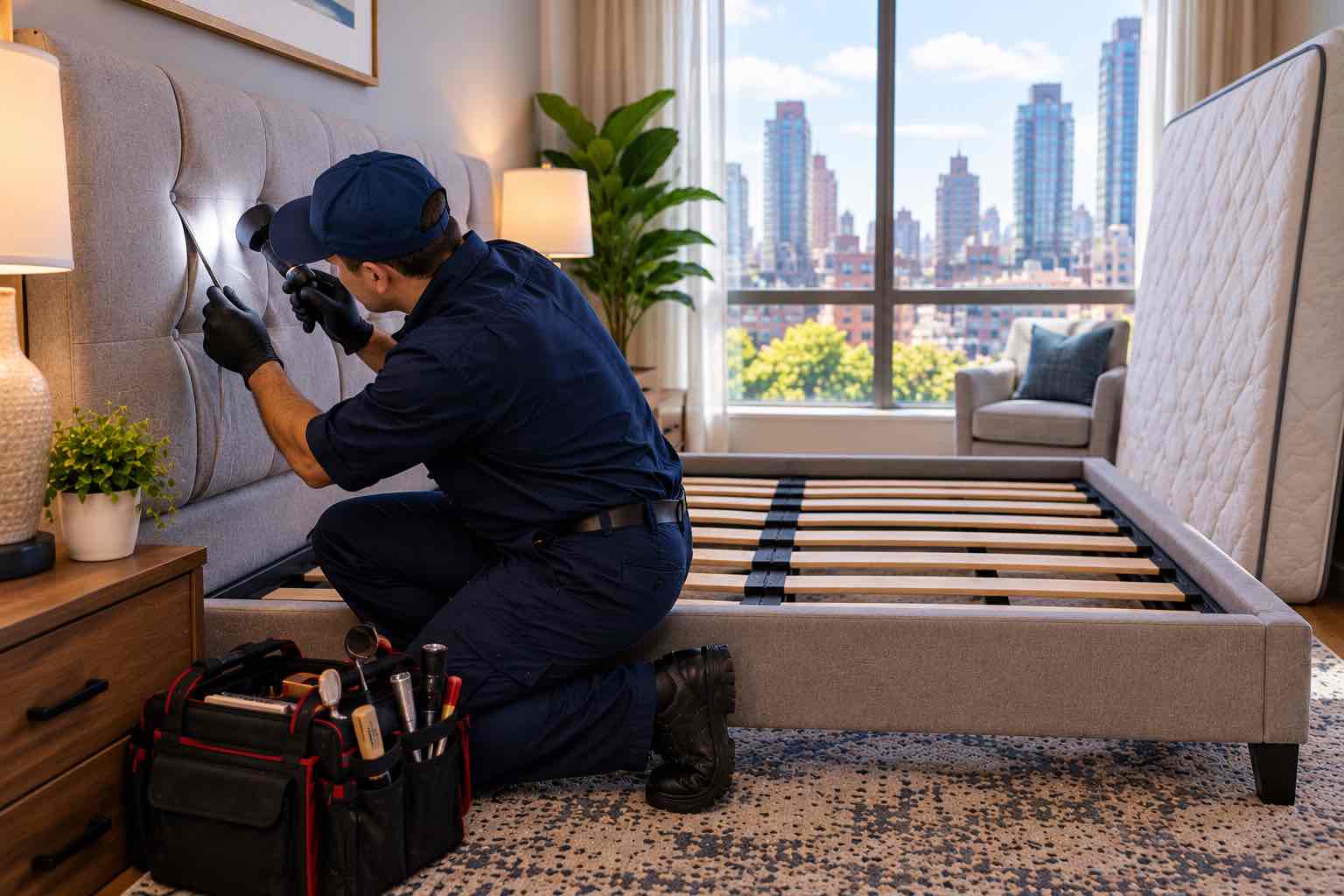
A professional bed bug inspection is not a walk-through. It is a methodical examination of every location where bed bugs are known to harbor in residential and commercial spaces. We use professional-grade flashlights and inspection tools to examine harborage points that a visual scan alone would miss.
Bed bugs are experts at concealment. They spend 90 percent of their time in harborage locations and venture out only to feed. An inspection has to go to them, not wait for them to appear. Our protocol covers every primary and secondary harborage location in a standard Manhattan apartment.
Primary inspection areas include mattress seams and tufts, box spring folds and frame joints, headboard crevices and attachment points, upholstered furniture seams and underframes, baseboards and wall-floor junctions, electrical outlet covers, curtain rod hardware, picture frames near sleeping areas, and nightstand interiors and drawer joints. In pre-war apartments, we also check behind radiator covers, inside door hinge barrels, and in any visible wall gaps or plaster cracks near the bed.
After the inspection, you receive a written report. The report identifies what we found, where we found it, and what we recommend. This document is yours to keep. It is useful for conversations with your landlord, your building’s management company, your insurance carrier, or a real estate attorney if the situation involves a legal dispute. For information on what to do after inspection, see our treatment process page.
Free Before Any Quote
We never charge for the inspection. You receive a written report with our findings and a treatment recommendation before any money is discussed. No pressure, no upsell. Just a clear picture of what you are dealing with.
Where Bed Bugs Hide in Manhattan Apartments
Understanding harborage behavior is what separates a useful inspection from one that misses an active infestation. Bed bugs prefer to stay within 5 to 8 feet of their food source, which in a bedroom means the sleeping area. But the specific locations within that radius vary by furniture type, building age, and how long the infestation has been present.
- Mattress seams and tufts: The most common primary harborage. Bed bugs cluster in the piping, tufts, and label areas of the mattress where the fabric creates a fold.
- Box springs: The underside of a box spring, particularly where the dust cover fabric attaches to the frame, is a favored harborage. We always inspect the underside.
- Headboards: Both the attachment hardware and the interior channels of hollow headboard frames are common spots. Wall-mounted headboards in newer buildings create wall-void access points.
- Baseboards: In pre-war Manhattan apartments with original wood baseboard molding, the gap between the baseboard and the floor is a well-used harborage path.
- Electrical outlets: Bed bugs use electrical conduit as a travel corridor between units in multi-family buildings. Outlet covers near the bed are inspected and are a key indicator of inter-unit spread.
- Upholstered furniture: Sofas, armchairs, and ottomans in the bedroom or sleeping area are secondary harborage locations, particularly in longer-established infestations.
- Curtain rods and hardware: The bracket hardware at the top of curtain installations is often overlooked. We check it.
- Luggage and stored items: Bed bugs can establish in stored luggage, particularly in closets adjacent to the bedroom. We note any high-risk stored items during the inspection.
NYC Local Law 69: What Landlords Are Required to Disclose
New York City Local Law 69 of 2017 requires landlords to provide written disclosure of bed bug infestation history to all prospective tenants before a lease is signed. Specifically, a landlord must disclose whether any unit in the building had a bed bug infestation during the previous year, and whether that infestation was treated.
This law applies to all residential rental units in New York City, including every borough and every Manhattan neighborhood. It covers both new leases and renewals. The disclosure must be in writing and must be provided before the lease is signed, not after move-in.
For landlords and property managers, maintaining an accurate bed bug infestation history requires documentation. That documentation starts with a professional inspection report. If you receive a bed bug complaint from a tenant, confirming whether the complaint is valid through a professional inspection, and documenting the outcome, is the first step in maintaining the records that Local Law 69 requires you to disclose going forward.
For tenants, if you moved into a Manhattan apartment and were not provided with a bed bug infestation history disclosure before signing your lease, you may have recourse under the law. A professional inspection that documents a current infestation can support a legal claim or a complaint to the New York City Department of Housing Preservation and Development.
We provide inspection reports that are clear, specific, and useful as legal documentation. Our written reports include the date of inspection, the specific findings, the harborage locations identified, and our treatment recommendation. For more about our full process, visit our bed bug removal page.
NYC Local Law 69 requires landlords to disclose bed bug infestation history in writing to prospective tenants before lease signing. Failure to comply exposes property owners to fines and potential tenant legal action.
Inspections for Hotels and Airbnb Hosts in Manhattan
Short-term rental properties and hotel rooms in Manhattan face a structurally different bed bug risk than residential apartments. High guest turnover means constant exposure to infested luggage from travelers arriving from across the country and internationally. A single guest with an active infestation at home can introduce bed bugs into a Manhattan Airbnb in a single overnight stay.
For Airbnb hosts and boutique hotel operators, the standard we recommend is a quarterly inspection program. This means a professional inspection every three months, regardless of whether you have received a complaint. The rationale is simple: early detection allows treatment before an infestation establishes across multiple rooms or, in a hotel environment, multiple units.
We provide inspection reports specifically formatted for property management use, including the inspection date, unit number, findings, and a clear outcome notation. These reports are useful for Airbnb dispute resolution processes when a guest claims a bed bug encounter and disputes the host’s account. A documented recent inspection with no findings is meaningful evidence in that context.
Under New York City housing code, short-term rental hosts are not exempt from bed bug remediation requirements. An active infestation in a rental unit, short-term or long-term, creates an obligation to remediate. The question is whether you discover it through proactive inspection or through a guest complaint. The former is significantly less damaging to your listing and your reputation.
Free Inspections Across All of Manhattan
We conduct bed bug inspections in every Manhattan neighborhood. Schedule online or call us for same-day service.