
Cockroach Exterminator Manhattan, NY | Get Rid of Cockroaches Fast
Professional cockroach extermination for Manhattan apartments, pre-war buildings, and multi-unit residential properties. Free inspection. Written report. Same-day response.
Quick Answer
A professional cockroach exterminator in Manhattan uses gel bait, residual insecticide, and crack-and-crevice treatment to eliminate German and American cockroach populations in apartments and buildings. Most Manhattan apartments see a significant reduction within 7 to 14 days after treatment, with full population control typically confirmed at a follow-up visit 2 to 3 weeks later.
Cockroach Extermination in Manhattan Apartments
Manhattan apartment buildings present a specific cockroach challenge. Dense pre-war construction, shared walls, shared plumbing chases, and the building-wide systems that connect units create pathways for cockroaches to move freely between apartments. An infestation in one unit is almost always a building-wide problem in its early stages, even if only one tenant has seen insects so far.
The two cockroach species most common in Manhattan residential buildings are the German cockroach and the American cockroach. German cockroaches are the small ones, typically 0.5 to 0.6 inches long, and are the more common kitchen and bathroom pest. They reproduce rapidly and establish large populations in tight spaces near food and moisture. American cockroaches are larger, typically 1.5 to 2 inches long, and are most common in basements, utility rooms, and building infrastructure.
Professional extermination is required because cockroaches develop resistance to over-the-counter products quickly, and store-bought sprays often scatter populations rather than eliminating them, making the infestation harder to treat. Professional-grade gel bait formulations combined with residual perimeter treatment are the current standard of care for cockroach elimination in residential settings.
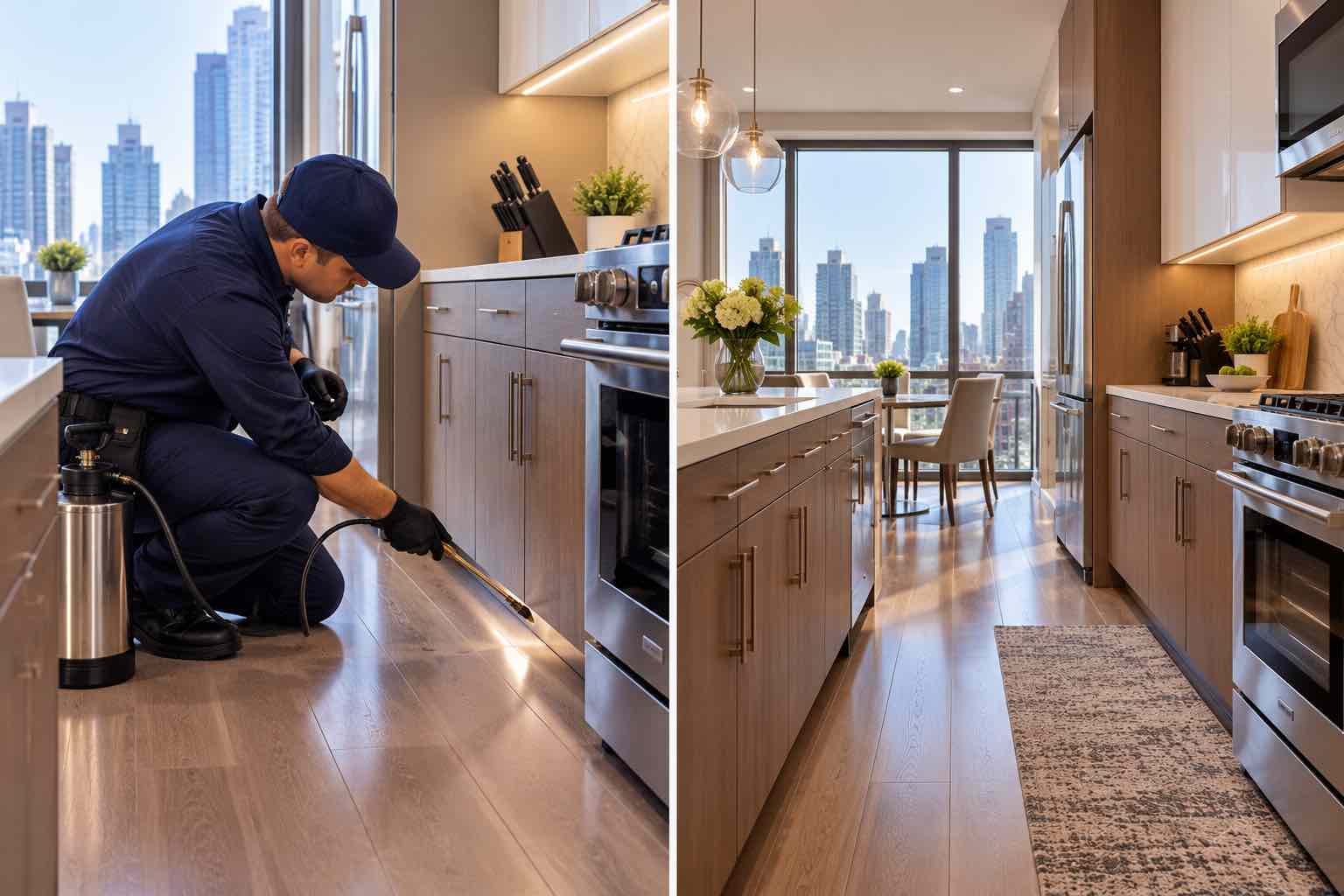
We treat every infestation with a multi-product approach: gel bait placed in harborage areas where cockroaches hide and feed, residual insecticide applied to perimeter surfaces and entry points, and crack-and-crevice treatment in the gaps and voids where cockroach populations establish. This combination works across the full population including egg cases, which are resistant to contact products alone.
What to Expect
After professional treatment, you may see more cockroaches than usual for 7 to 10 days as the bait drives them into the open. This is a sign the treatment is working, not a sign of failure. Population levels drop sharply in the second week. The follow-up visit at 2 to 3 weeks confirms the outcome.
Where Cockroaches Hide in Manhattan Apartments
Cockroach treatment is effective only when the application reaches the actual harborage areas. Spraying visible surfaces where cockroaches pass through does not eliminate the population. We treat where they live, not just where they travel.
Kitchen Harborage Areas
German cockroaches concentrate in the kitchen because it provides food, moisture, and warmth. Primary locations include: inside and underneath the refrigerator motor housing, behind and beneath the stove, inside cabinet hinges and the underside of cabinet shelving, around the dishwasher motor, and behind the kick plate under lower cabinets. We place gel bait and treat cracks at all of these locations.
Bathroom and Plumbing Areas
Cockroaches follow plumbing because it provides moisture and travel corridors between floors and units. We treat behind the toilet, around the base of the sink and vanity, under the bathtub access panel, in the void behind the shower walls at access seams, and around pipe penetrations in walls and floors. In pre-war buildings, these penetrations are often unsealed and serve as the primary pathway for inter-unit spread.
Building Infrastructure
American cockroaches and large German cockroach populations move through building-wide infrastructure: basement utility areas, elevator shafts, garbage chutes, and shared mechanical rooms. For building-wide infestations, we coordinate with property management to treat common areas and building infrastructure in addition to individual units, since unit-only treatment will result in re-infestation from untreated building areas.
The Manhattan Cockroach Problem: Why Buildings Matter
In Manhattan apartment buildings, particularly pre-war construction from the 1900s through the 1940s, cockroach control requires building-level thinking even when a single unit is being treated. The structural characteristics of these buildings create a connected environment where cockroaches move between units through:
- Plumbing chases: The vertical shafts that carry plumbing between floors are shared across units on the same riser and are rarely sealed between floors in pre-war construction.
- Electrical conduit: Conduit runs between units and between floors, creating travel corridors that are difficult to access for treatment.
- Shared walls: Gap-filled plaster in older walls, particularly around plumbing and electrical penetrations, creates horizontal travel corridors between adjacent units.
- Shared building systems: Garbage chutes, trash areas, and basement storage that serve multiple units are consistent re-infestation sources when not treated as part of a building-wide program.
When we treat a single unit in a multi-unit building, we document our findings and can provide a written report suitable for sharing with building management if you need to make the case for building-wide treatment. We can also treat multiple units in the same building under a coordinated program, which is the most effective approach when a building-wide infestation is confirmed.
Serving All Manhattan Neighborhoods
We provide cockroach extermination throughout Manhattan. Same-day response available.