
8 Signs You Might Have Bed Bugs in Your Manhattan Home
Quick Answer
The 8 signs of bed bugs in a Manhattan apartment are: unexplained bites on exposed skin, small blood stains on sheets and pillowcases, dark fecal spots on mattress seams or baseboards, shed exoskeletons near harborage areas, a musty odor in the bedroom, live insects in mattress seams or furniture folds, pale white eggs in harborage areas, and bite clusters in a line or group pattern on skin.
Most Manhattan residents who have bed bugs do not know it at first. Bed bugs are cryptic insects that spend 90 percent of their time in concealed harborage locations and feed only when you are asleep. The early signs of an infestation are subtle and easy to dismiss as something else: a mosquito bite, a skin reaction, a stain on the sheets. By the time the evidence is undeniable, the infestation is usually well-established. Knowing what to look for early gives you the best chance of catching and treating the problem while it is still limited in scope.
Sign 1: Unexplained Bites on Exposed Skin
Bed bug bites appear on skin that was exposed during sleep: the face, neck, arms, hands, and lower legs. They are typically small, red, and itchy, and they may not appear until 24 to 48 hours after the actual bite. Some people have no visible reaction at all, which is why bites alone are not a definitive indicator of bed bugs. But unexplained bites that appear overnight, particularly on exposed skin and particularly after you have been in a new location (a hotel, a recently furnished apartment, a home where a visitor stayed), are worth investigating.
Bed bug bites are often confused with mosquito bites, flea bites, or allergic reactions. The distinguishing features are the location on the body (always exposed skin in sleeping positions), the timing (bites appear after sleeping), and the pattern described in sign 8 below.
Sign 2: Small Blood Stains on Sheets and Pillowcases
Small rust-colored or red stains on sheets and pillowcases are a classic early sign of bed bugs. These stains come from two sources: a bed bug that fed and was accidentally crushed when you rolled over in sleep, releasing the blood meal it had just consumed; and small amounts of blood left at the bite site after feeding. These stains are typically small, a few millimeters across, and are often found near where you sleep, on pillowcases and near the center of fitted sheets.
If you see these stains and cannot account for them from another source, it is worth inspecting the mattress seams and box spring immediately.
Sign 3: Dark Fecal Spots on Mattress Seams and Baseboards
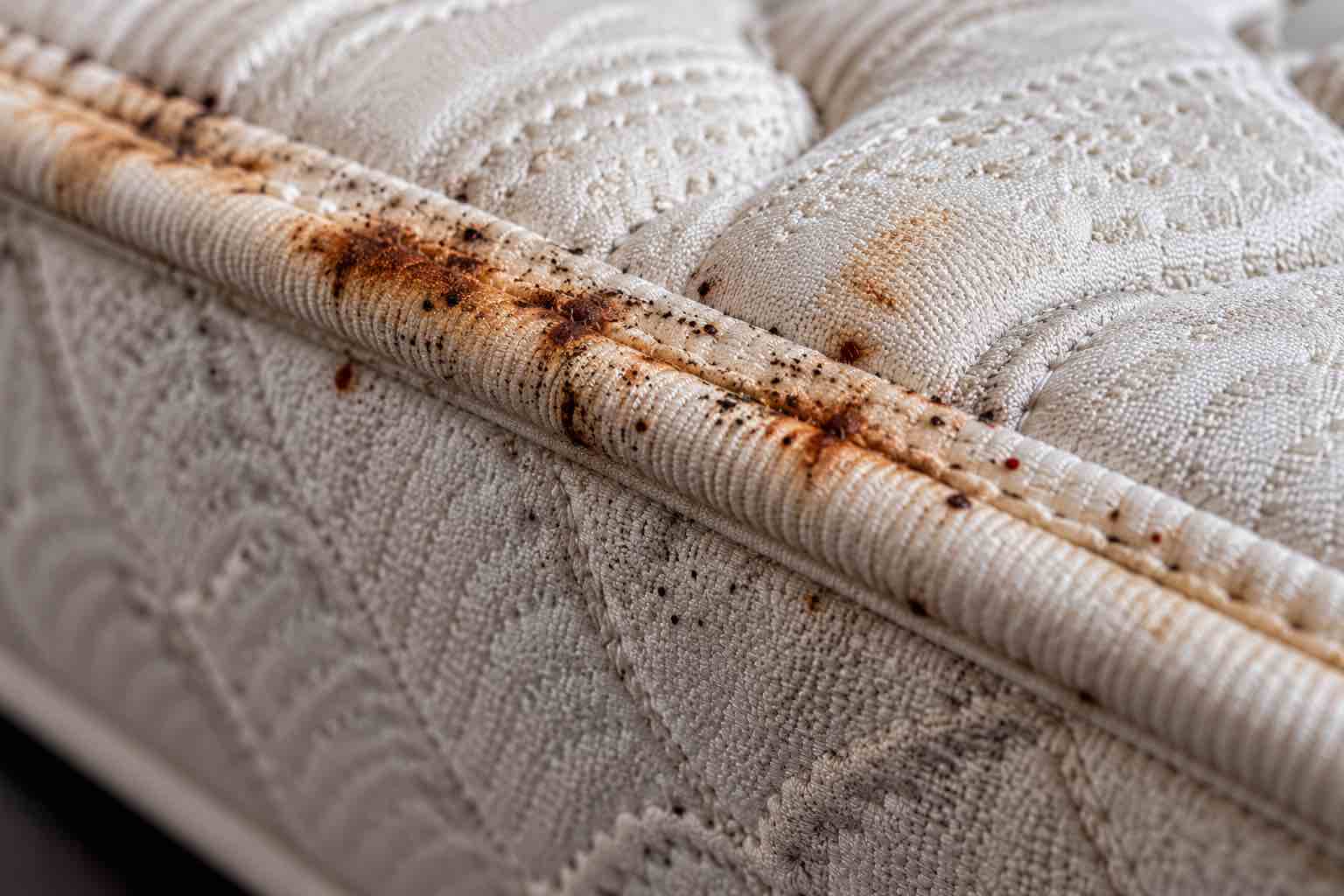
Bed bug fecal matter is one of the most reliable early signs of an infestation. It appears as small dark spots, roughly the size of a period at the end of a sentence, that are slightly raised from the surface and that bleed into fabric like a felt-tip marker dot when you press them. The spots are dark brown to black in color and are found at harborage locations: mattress seams and tufts, the fabric where the box spring cover attaches to the frame, along baseboards in the bedroom, on the underside of nightstand drawers, and behind headboards.
Fecal spotting is a definitive sign of bed bug presence. It is not always easy to see without a bright light and careful examination. Using a flashlight to examine the piped edge of the mattress all the way around is the fastest way to check for this sign.
Sign 4: Shed Exoskeletons (Molted Skins)
Bed bugs go through five nymphal stages before reaching adulthood, shedding their exoskeleton at each stage. These shed skins, also called cast skins, are pale tan to light brown and hold the exact shape of the bed bug at the stage it molted from. They are found in harborage areas alongside fecal spots and eggs. The shed skins are clear evidence that a bed bug population has been living in the harborage area long enough to molt, which typically requires feeding at least once per nymphal stage.
Finding multiple shed skins in the same harborage location indicates a population that has been present for at least several weeks and has been successfully feeding throughout that time.
Sign 5: A Musty Odor in the Bedroom
A heavy bed bug infestation produces a distinctive musty odor that is often described as similar to berries, coriander, or a slightly sweet-sour smell. This odor comes from pheromones produced by the bed bugs and is more noticeable in confined spaces with large populations. In a Manhattan studio apartment with a heavy infestation, the odor may be detectable when you walk in after the apartment has been closed up for several hours.
A musty bedroom odor without another obvious source is worth investigating, particularly if it is accompanied by any of the other signs on this list. The odor alone is not specific to bed bugs and can have other causes, so it should be considered in conjunction with other signs rather than in isolation.
Sign 6: Live Bed Bugs in Mattress Seams or Furniture Folds
Seeing a live bed bug is definitive confirmation that you have an infestation. Adult bed bugs are brown, oval-shaped, and approximately 4 to 5 millimeters long, roughly the size and shape of an apple seed. They move quickly when disturbed and are most active in the dark, so they are easier to spot with a flashlight during early morning hours rather than during the day.
Nymphs, the juvenile stages, range from 1 to 4 millimeters and are pale translucent white to light tan. They are harder to see because of their size and coloration. Both adults and nymphs are found in the mattress seam, inside the box spring, in the joints of the bed frame, and in the folds of upholstered furniture near the sleeping area.
If you find a live insect you think is a bed bug, take a photo or capture it in a sealed container. This is the most useful thing you can bring to a professional inspection: a specimen photograph or the insect itself is the fastest way to confirm the identification.
Sign 7: Pale White Eggs in Harborage Areas
Bed bug eggs are approximately 1 millimeter long, white to pearl-colored, and shaped like a tiny grain of rice. They are found in clusters in harborage areas, often in areas with fecal spotting and shed skins. They are sticky when newly laid and attach firmly to fabric and wood surfaces. Eggs are difficult to see without magnification and a bright light source.
Finding eggs in a harborage area means the infestation has an established breeding population, not just a few bugs introduced from elsewhere. This is an important distinction for treatment planning because it means the population is self-sustaining and will grow without intervention.
Sign 8: Bites in a Line or Cluster Pattern
The bite pattern is one of the more reliable behavioral indicators of bed bugs when bites are visible. Bed bugs often feed in a linear pattern along blood vessels, moving incrementally down the skin. This produces a characteristic “breakfast, lunch, and dinner” pattern of three or more bites in a row or a cluster on the same area of skin.
This pattern is not universal. Some people react differently, and single bites do occur. But a cluster or line of similar-looking bites on exposed skin, appearing after sleep, is a specific enough pattern to warrant immediate inspection of the mattress and bedding.
What to Do If You See These Signs
If you see one or more of these signs in your Manhattan apartment, the right response is a professional inspection, not a store-bought spray. Over-the-counter products are not effective against established bed bug populations and typically scatter the infestation rather than eliminating it. A professional inspection costs nothing with us and gives you a definitive answer and a clear treatment recommendation.
Do not throw out your mattress or furniture before the inspection. In most cases this is unnecessary and it risks spreading the infestation through your building’s hallways and shared spaces. Call us at (914) 543-2756 or visit our inspection page to schedule. For an overview of what treatment involves, see our treatment process page.



4 Comments